ATA Carnet Customs Clearance – Temporary Import and Export Guide
ATA Carnet Customs Clearance – Temporary Import and Export Guide
ATA Carnet Customs Clearance – Temporary Import and Export Guide

SHARE THIS ARTICLE
RECENT ARTICLES
Unleash the potential of your business with Ex-works
Ex-works has assisted companies globally in imports and exports. Allow us to handle all your shipments so you do not face any challenges during the customs clearance process in the Philippines. We also offer customs clearance services at a small cost if you need to deliver urgently and save time. Open an account today with Ex-works, and let us assist your business in overcoming the obstacles of international customs.
SHIP IN MORE THAN 180 COUNTRIES
-
Wholesale Rate
-
Global Network
-
Online Tracking
-
Simplified Shipping
GROW YOUR BUSINESS FROM ANYWHERE.
SUBSCRIBE TO EX-WORKS24/7 NEWS LETTER
ATA Carnet Customs Clearance - Temporary Import and Export Guide
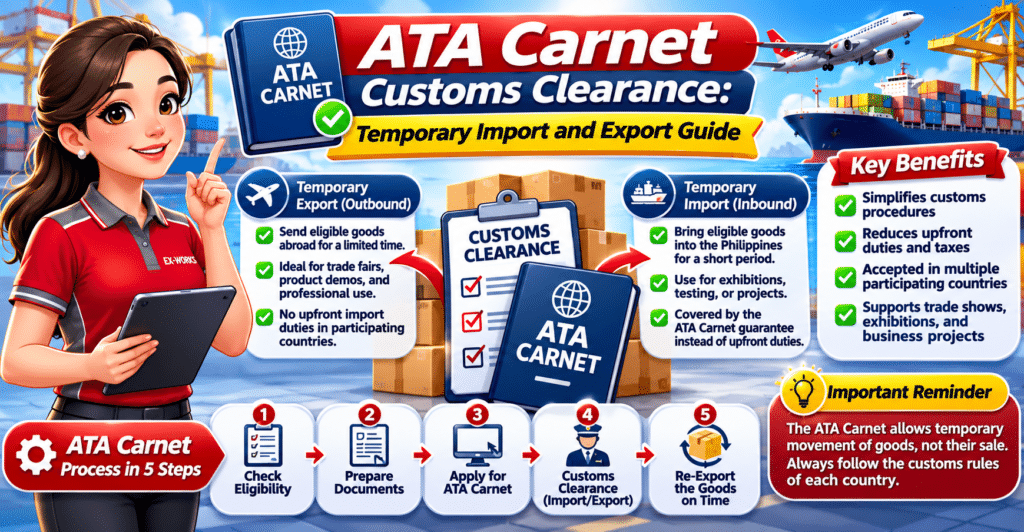
Temporary Import allows businesses to bring eligible goods into another country for a limited time without paying normal import duties upfront. The ATA Carnet system makes this process easier through one customs document accepted by participating countries. It supports trade fairs, product displays, and professional equipment. However, traders must follow local rules and return their goods within approved periods. Proper planning helps reduce customs delays, protect business costs, and support smooth international trade.
Temporary Export also plays a key role when Philippine businesses send goods overseas for short projects or events. An ATA Carnet can simplify border checks and reduce paperwork across participating customs territories. However, it does not replace required permits or cargo insurance. Importers and exporters must maintain accurate records, meet customs deadlines, and secure proper endorsements. Understanding these duties helps businesses manage risks and avoid unexpected customs charges.
Table of Contents
ATA Carnet Customs Clearance for Temporary Import and Export
Temporary Import procedures allow eligible goods to enter a participating country without standard upfront duty payments. The ATA Carnet serves as both a customs document and a guarantee for duties and taxes. Businesses can use it for trade samples, exhibition goods, and approved professional equipment. First, traders must confirm that their goods qualify under the destination country’s rules. They must also prepare accurate item descriptions, values, and supporting records. Customs officers may inspect shipments and verify their stated purpose. In addition, the holder must meet the deadline for re-export. A carnet generally remains valid for up to one year, but customs may set shorter limits. Missing deadlines can lead to claims for duties and taxes. For this reason, businesses should review their shipping plans before departure. Clear records and proper coordination help prevent delays at international borders.
Temporary Import: ATA Carnet Requirements and Documentation
Temporary Import under the ATA Carnet system requires careful document preparation before goods cross international borders. Businesses should prepare a detailed general list showing each item’s description, quantity, value, and country of origin. Serial numbers can help customs officers identify valuable equipment during inspections. Moreover, the holder should confirm the goods’ intended use and destination. Certain products may require licenses, permits, or separate approval. The carnet does not remove these legal requirements. Customs authorities may also check whether goods match the declared list. Therefore, accurate records are essential for smooth customs clearance. Traders should keep invoices, packing lists, and shipping documents ready when needed. They must also obtain the required customs endorsements during entry and exit. Missing records can create problems when authorities review the shipment. Early preparation helps businesses reduce errors and manage temporary import procedures more effectively.
Temporary Export: ATA Carnet Procedures for Philippine Businesses
Temporary Export allows Philippine companies to send eligible goods abroad with plans to bring them back. The ATA Carnet can support trade shows, overseas product displays, and short business projects. Before shipment, exporters should confirm the destination accepts carnets for their intended goods and use. Next, they should prepare the general list and secure the required carnet from the authorized issuing body. Customs officers may examine the goods before departure. They may also record their export through the carnet. Upon arrival abroad, the holder must present the document for temporary admission. Furthermore, customs endorsements help prove that the goods entered and left each territory. Exporters should track return dates and retain shipping records. The goods must meet the conditions for re-export and return. Careful planning can reduce customs disputes and support smooth international movement.
Temporary Import and Export: Customs Duties, Taxes, and Bonds
Temporary Import and export arrangements can reduce upfront customs payments when goods meet ATA Carnet requirements. The carnet guarantee protects customs revenue if the holder fails to follow the rules. For example, duties and taxes may become payable when goods remain abroad beyond the approved period. The guarantee does not mean customs charges can never arise. Importers must also understand that an ATA Carnet is not cargo insurance. Cargo insurance may cover physical loss or damage, depending on the policy terms. Meanwhile, the carnet guarantee addresses potential customs liabilities. These two forms of protection serve different purposes. Businesses should review both before shipping valuable equipment or trade samples. In addition, traders should confirm all fees with the authorized issuing body. Costs may include document fees and guarantee charges. Clear planning helps businesses manage customs and transport risks.
Philippine ATA Carnet Rules and Customs Procedures
Temporary Import under the Philippine ATA Carnet system follows rules issued by the Bureau of Customs. The country launched the system with the Philippine Chamber of Commerce and Industry in July 2024. PCCI serves as the designated National Issuing and Guaranteeing Association for the Philippines. Customs Administrative Order 02-2022 sets the main rules, while CAO 01-2023 introduced amendments. Customs Memorandum Order 08-2024 provides detailed procedures for implementation. These rules cover eligible goods, customs processing, guarantees, and monitoring. For example, exhibition items, professional equipment, and commercial samples may qualify under applicable conditions. However, not every product qualifies for duty and tax relief. Traders must follow the specific rules for each approved category. The Bureau may inspect goods and verify carnet records. Businesses should review the latest official guidance before arranging shipments.
Planning Cargo Movement and Customs Inspections
Temporary Export shipments require coordination between the exporter, freight forwarder, customs broker, and receiving party. First, businesses should confirm the shipment schedule and prepare a clear packing list. They should also check whether the goods need permits from other government agencies. Freight forwarders can arrange transport, cargo handling, and delivery plans. Meanwhile, customs brokers can help traders understand clearance steps and supporting records. The carnet holder must still meet all customs obligations. At each relevant border, customs officers may inspect the goods and record their movement. Traders should keep the carnet accessible throughout the journey. In addition, cargo insurance can help manage transport risks when suitable coverage applies. The insurance policy should match the goods, route, and declared value. Good planning supports timely delivery and safe handling. It also helps businesses maintain clear records for the return shipment.
Avoiding Delays and Customs Compliance Problems
Temporary Import shipments can face delays when documents contain errors or goods differ from their declared details. For this reason, traders should review every item before shipment. They should check serial numbers, quantities, values, and planned return dates. Customs may request additional proof when records do not match the cargo. Moreover, the carnet holder should keep copies of customs endorsements and transport documents. Missing proof of re-export may lead to a customs claim. If shipment plans change, businesses should contact the relevant customs authority before the deadline. Selling or leaving goods abroad may require approval and payment of applicable charges. Traders should not assume that a carnet permits unrestricted use. Instead, they should follow the approved purpose and conditions. Accurate records, early communication, and timely action help reduce avoidable customs problems.
How ATA Carnet Services Support Philippine Trade
Temporary Export and import services help Philippine businesses join overseas events and manage short-term projects. The ATA Carnet system can reduce paperwork and ease temporary customs admission in participating territories. However, its benefits depend on correct use and compliance with local rules. Companies should review their shipping needs before choosing this customs procedure. A qualified logistics provider can help arrange freight, prepare supporting documents, and coordinate customs clearance. For example, Ex-works Cargo Services Inc. can position its support around freight planning, document preparation, and customs coordination. Carnet issuance remains the responsibility of the authorized issuing body. Businesses should confirm service scope, fees, and shipment requirements before making commitments. With careful preparation, traders can manage costs and improve shipment control. Clear customs records also support the timely return of goods. Ultimately, sound planning helps businesses participate in international trade with greater confidence.
Related Links
Frequently
Asked Questions
The Philippines launched its ATA Carnet system in July 2024. The Philippine Chamber of Commerce and Industry serves as its issuing and guaranteeing association. Traders should check current application steps, eligible goods, fees, and required records before arranging shipments abroad.
Eligible goods may include exhibition items, commercial samples, and professional equipment. Each destination applies its own accepted categories and conditions. Check the goods list, planned use, and required permits before shipping. Items intended for sale generally need different customs procedures.
An ATA Carnet normally remains valid for up to one year. However, customs may require goods to leave sooner. Check the deadline set at each border and arrange re-export. A valid carnet alone does not extend a shorter customs deadline.
The carnet holder presents the document and listed goods to customs at each required crossing. Officers may inspect items and endorse records. Keep the carnet accessible, confirm each endorsement, and retain shipping evidence until the temporary admission is fully closed.
An ATA Carnet may remove the need for upfront duties and taxes on eligible temporary imports. However, relief depends on compliance with customs conditions. Goods kept, sold, or used outside approved terms may trigger charges and other customs requirements abroad.